How a brother’s kidney provided a perfect match for quadruple amputee sister
OVERLAND PARK, Kan. (InvestigateTV) - Growing up, George Morgan was the kind of older brother who gifted his younger sister an introduction to The Beatles and poetry structure.
On the outside, George and his sister, Brie Morgan Bauer, are like the typical brother and sister relationship -- just separated by a 10-year age gap.
“She’s always had an extremely stubborn streak,” George said. “Having two older brothers that would pick on her, she would just fight to the point that we were no longer picking on her.”
This February, Brie’s older brother gave her the best birthday gift anyone could ever ask for. It was what was inside the siblings that allowed for a gift that was the introduction to a new freedom in the quadruple amputee and mother of three’s new life.
The siblings, who have another brother and sister, could never have guessed how their story would unfold.
“He’s always had this thought of caring for me,” said his sister, Brie Morgan Bauer.
In February of 2024, with her shoulders feeling stiff, Brie went to the doctor, thinking her husband’s recent battle with the flu had resulted in her getting sick. Hours later, she was having contractions and was taken into an emergency cesarean section for her third pregnancy, which left her in a coma for 10 days due to septic shock and organ failure.
Doctors amputated all four of her limbs over the course of numerous surgeries.
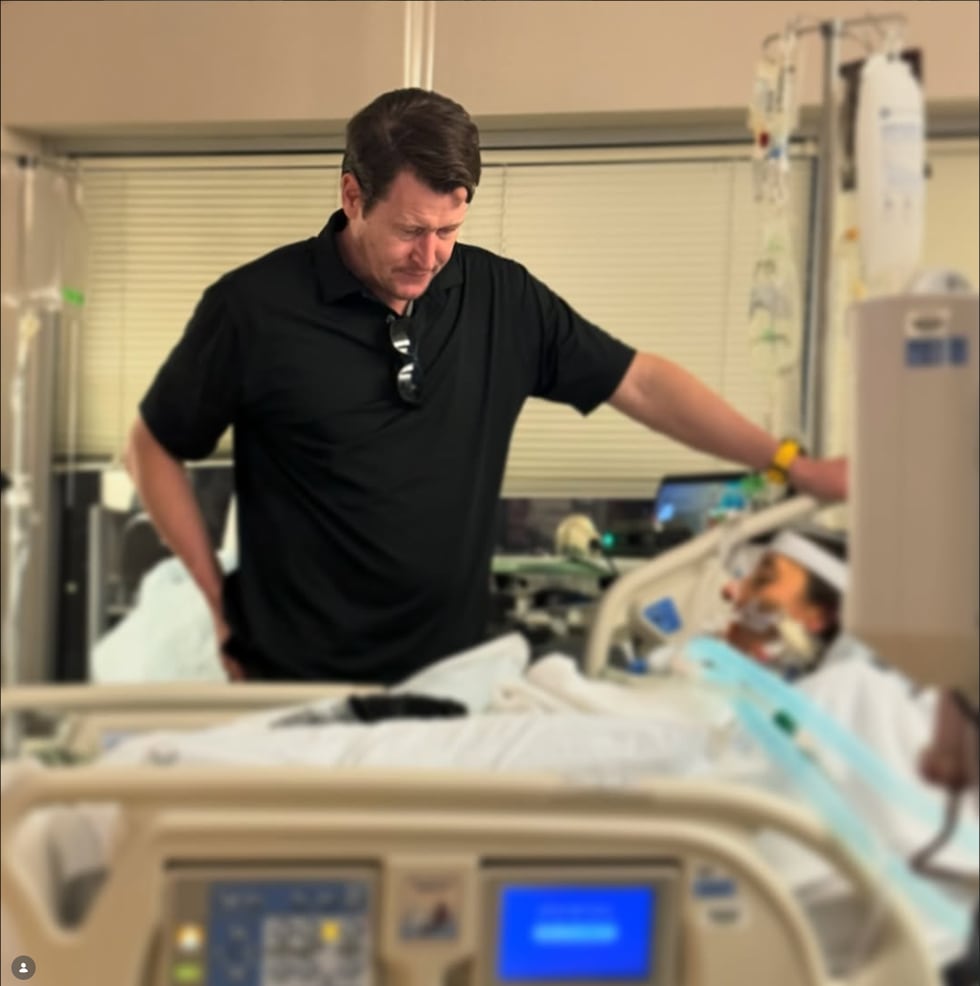
Bauer was left in need of a kidney and spent roughly 16 hours per week on dialysis as a result.
“Very, very difficult to just have nothing you can do to change an outcome,” George said. “There was a part of me kind of knowing her personality, like, I’m pretty sure she’s just going to fight against this, too.
“She has that stubborn streak that she’s like, ‘I’m not gonna let this get me. I’m going to find a way forward.’”
The front office of Brie’s Overland Park home featured a dialysis machine that her husband, Reid, learned how to operate “like a trained nurse.”
The match
In late January, when Bauer visited with KCTV at her home, she teared up at the idea that none of her three siblings was a match for her need (she has Type 0 negative blood).
On Christmas Day in 2025, Brie’s sister told her she wasn’t a match. Her other brother also went through testing and was not a match.
“I was crushed,” she said.
“After I learned that, I didn’t even think about anything else,” Brie said. “I didn’t even think about the last few things that George had to do... I was terrified that we weren’t going to be able to find a match because it usually is a sibling.”
George, who lived in Colorado, was going through the process but hadn’t completed testing. Brie thought her brother’s process was finished and assumed, after not hearing anything, that her third and final sibling was not a match.
“It was like I don’t want the heartache to hear that again,” she said. “I’ll just assume and keep pushing forward with what I can do.”
As Brie advocated for people to call the The University of Kansas Health System and tried educating the public on what it means to be a donor or part of the Paired Exchange Program, her brother continued through the process.
“I never assumed that any of (the siblings) would be a match,” George said. “My research was like the chance of this is very, very minimal. It was just going to be through a trade of some sort.”
In the middle of a hike on a mountain in Colorado, George somehow managed to get the cell service required to take a phone call from The University of Kansas Health System.
“(The doctor) kind of slow played it at first, but she was like, ‘You are a perfect match for your sister,’” he recalled of the phone call. “I’m like, ‘Say that again. I just want to make sure I’m understanding exactly what you’re saying.’”
Doctors explained that George’s kidney was a better genetic fit than anyone else’s could possibly be.
“To have a chance to do something, make a sacrifice, and to have that be for a family member is just that much more impactful,” he said. “So it just fills me with just a feeling of gratitude.”
The gift
Brie woke up on Feb. 6, 2026, for her 37th birthday with rehab and dialysis on her schedule.
“And I didn’t want to see anyone,” she said. “I just wanted to lay down and watch TV. But my mom was adamant, ‘No, we’ve gotta do this. We’ve gotta do it for your kids. Sing the birthday song and blow out candles,’ and I was like, ‘fine.’”
A FaceTime call between the siblings ensued, and George delivered Brie the birthday gift of a lifetime.
“Here is a coupon for one pre-owned kidney,” read George’s text message, which their mother printed out for Brie.
“Sometimes I read things and I don’t read it correctly,” she said. “So I was so confused when I read the note.”
When someone in the room asked if George was a match, their mother screamed, “Yes!”
“And everyone just started freaking out,” Brie said.
“I looked at him, and I just saw my dad’s eyes come through,” she said. “And that’s what made me kind of emotional is, if my father was here and how proud he would -- how proud he would be of (George) stepping up like this.”
More than two years after George spent days and nights by his sister’s bedside for surgery after surgery, the pair were back in the hospital for a joyful occasion. On March 25, Brie and George underwent surgery for the kidney transplant.
“I love you Brie,” George said as he went back for surgery, cracking a joke to guide the siblings into the operating room with a bit of humor.
“Thank you so much,” his sister responded.
What’s next?
The kidney transplant surgery was a success for both Brie and George and has helped Brie get the new life that she envisioned every day during her dialysis treatment.
“I’m just trying to absorb what this new life is,” Bauer said. “Subconsciously, I’m just pushing away what happened and thinking of this as a new perspective.”
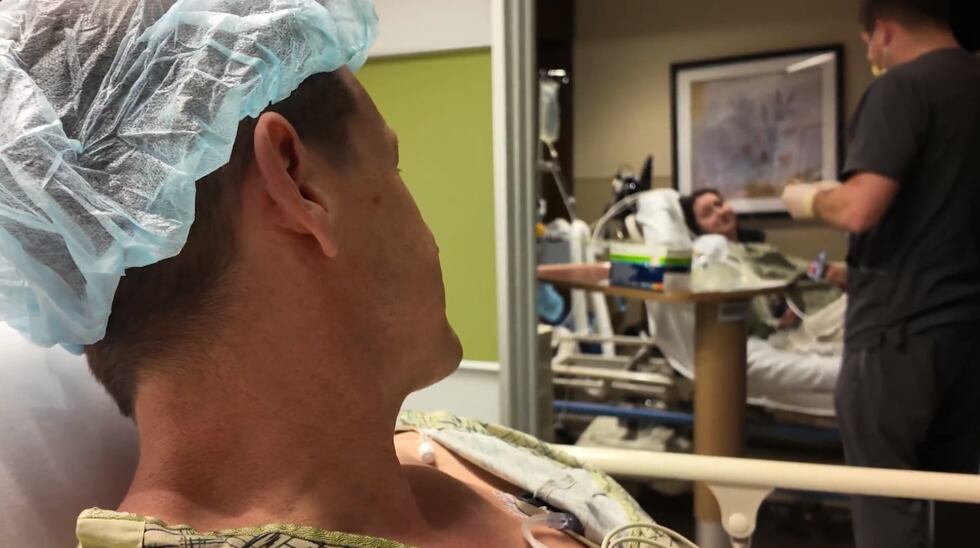
Now, the successful surgery may sound like the end of Brie’s story, but it’s really just the beginning. Having a functioning kidney means she’ll have less swelling and can finally start the process of working toward prosthetic use.
The front office of the Bauer home featured a dialysis machine and some of Brie’s paint cans and canvases. She has hopes of turning the room and its newfound space into a more complete art studio.
“I very much appreciate the fact that I could do it at home,” Brie said of the dialysis treatments, “but I’ll be happy when that’s gone. And hopefully turn the room into a paint studio or something.”
But Brie says the biggest gift the kidney provides is time, which she yearned for when she spoke to KCTV in February. Uncle George’s birthday gift gives Brie time off dialysis and back with her boys. Beau, who was born at 27 weeks and at just over 2 pounds, is healthy and growing, often climbing on Brie’s wheelchair.
“I’m just really excited to see what I can accomplish now,” Brie said.
For more on Brie’s foundation, Brie’s Hope, click here.
Copyright 2026 Gray Media Group, Inc. All Rights Reserved.